鼠凭社贵的意思出自哪里?带你了解背后故事!

The search results confirm the meaning of "鼠凭社贵":
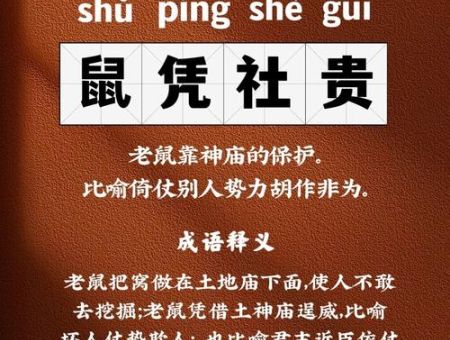
"老鼠把窝做在土地庙下面,使人不敢去挖掘。比喻坏人仗势欺人。" This is the core meaning.
It's a "贬义成语" (derogatory idiom).
Originates from "南朝梁·沈约《恩悻传论》:“曾不知鼠凭社贵,狐藉虎威。”"

Similar to "狐假虎威" (the fox borrows the tiger's might) or "狗仗人势" (a dog relies on its master's power to bully others).
So, the phrase specifically refers to a bad person who relies on someone else's power to bully others or gain undue advantage. This is important for the nuance of the story. It's not just about gaining status, but often about abusing that status.
Now, I can weave this into a personal narrative, focusing on observation and realization, rather than a direct explanation of the idiom. I'll need to create a character and a scenario that fits the "bad person仗势欺人" aspect implicitly.
I will structure the story around an observation in a work context, where a less capable individual gains unwarranted influence or power due to a specific association.
Refined Narrative Plan:
1. Introduction: Start with a general thought about how some old sayings just hit different when you experience them. Mention "鼠凭社贵" as one such phrase.
2. Setting the Scene: Describe a past job or project. Emphasize the normal, competitive environment. Introduce a colleague, let's call him小李 (Xiao Li), who wasn't particularly outstanding.
3. The Shift: Xiao Li suddenly gets assigned to a "special project" or "key team" directly under a big boss or a powerful department (the "社" or "altar"). This immediately changes his standing.
4. Observation of Change:
Previously, his opinions were barely considered. Now, people actually listen to him, even seek his input on things he clearly knows little about.
He becomes arrogant, makes demands, and even subtly "bullies" others (the "仗势欺人" part). Perhaps he starts bossing around people who were more senior or skilled than him.
Show, don't tell: Describe specific instances of his newfound "power" and how others reacted.
5. The Realization: I notice this whole dynamic and it triggers a memory of the phrase "鼠凭社贵". I might not have fully grasped its meaning before, but seeing Xiao Li's transformation makes it crystal clear. The "rat" (Xiao Li) gets "noble" (important, powerful) because of the "altar" (the influential project/boss/department).
6. Internal Reflection/Connecting to Deeper Meaning: I reflect on how often this happens in life – not just in work, but everywhere. People gaining influence or respect not for their own capabilities, but for their connections or the platform they're on. The underlying cynicism or unfairness of it.
7. Consequences/Lessons Learned:
How it affects team morale or fairness.
My own choices: do I try to "凭社贵" or focus on my own abilities? (I'd lean towards the latter to maintain a positive, self-reliant blogger image).
The bitter taste it leaves, but also the clarity it brings about how the world sometimes works.
8. Concluding thought: Reiterate that these old sayings are like mirrors, reflecting human nature across centuries. End with a subtle takeaway about being aware of such dynamics without explicitly moralizing.
This plan aligns with the blogger's style, word count, and content requirements.